

Considering the matter as an abstract question, the argument . . . preponderates in favor of granting them the rights. They are subject to taxation and to the control of the laws, and hence . . . they should be permitted to vote . . .But then the article takes a turn:
[I]f . . . the better class of ladies desire this privilege [i.e. of voting], we shall be the very last to raise our voice in opposition. . . . [B]ut on the contrary [we] are well convinced that they do not wish, nor neither would they exercise the right if it was forced upon them.And rides that train of thought to its conclusion:
[I]t would not be the refined, intelligent, moral and religious portion of [women] who would turn out and press their way to the polls, through crowds of drunken, profane and filthy men; but, on the contrary, it would . . . be the ignorant, debased and immoral . . . [W]e should very much regret to have the right of female suffrage ingrafted into any of our State Constitutions.However, a brief announcement posted on the same page of the same newspaper issue can be read as a pointed rebuttal:
A Woman’s Suffrage Association has been organized in St. Louis, and an effort is to be made to amend the Constitution of the State so as to give them the right of voting.And so the battle begins.
This online exhibition explores how the fight for women’s suffrage in Illinois and nationwide played out 100 years ago in Madison County. The exhibition features images and artifacts from the collections of the Madison County Historical Society. It was written and designed by Mary Z. Rose, Assistant Curator at the Madison County Historical Museum and Archival Library. Please send your feedback and/or any questions about this exhibition to madisoncountyhistoryil@gmail.com.
Forceful Females
The argument that only the coarsest of women would exercise the right to vote persisted for several years. In fact, those who opposed suffrage for women asserted that participation in politics at any level would corrupt modest and moral women.

And yet, by the mid-1880s even the Alton Telegraph took notice of the "forceful females" leading the fight for equal suffrage. A correspondent to the March 1884 Women's Suffrage Convention in Washington, D.C., described them as "neither old nor ugly, but fat, fair and forty, with a mission and courage to execute it."
Susan B. Anthony presided over the convention "in a well-fitting and well-made black dress, with ruffles at the sleeves and of lace at the throat … and a bonnet more striking for the value of the materials that for any striking display." (Alton Telegraph, March 31, 1884)
The correspondent also noted that most of the suffragists in attendance didn't wear bangs, even though bangs were in vogue.

Illinois Women Organize
The Illinois Equal Suffrage Association formed in 1869, the year Congress passed the Fifteenth Amendment legislating suffrage for African American men. The Association's mission? "The political enfranchisement of women."


"Storming the Capitol"
On April 4, 1909, women "stormed the [Illinois] Capitol" wearing yellow flowers (a suffragist symbol) and "marvels of millinery" to advocate for a suffrage bill. The women draped the galleries with "a monster petition bearing 15,000 names." (Alton Evening Telegraph, April 15, 1909)
At the end of the day, the Senate Committee on Elections recommended the passage of a bill granting women limited voting rights. The Billings Bill proposed permitting women to vote for presidential electors, state board of equalization members, appellate court clerk, county collector, county surveyor, board of assessors members, board of review members, and all city officers. The Committee recommendation was a suffragist win, but the Billings Bill did not end up being the vehicle for women's suffrage in Illinois.

The Alpha Suffrage Club

Journalist and anti-lynching activist Ida B. Wells founded the Alpha Suffrage Club in January 1913, probably the first African American women's suffrage group. The organization rallied women to support candidates serving the interests of Chicago's black residents.
The American Woman's League

The American Woman's League (AWL) was created by magazine publisher Edward Gardner Lewis. The League had a dual purpose: to promote educational and political opportunities for women and to promote Lewis's magazines. White women (the AWL didn't admit black women) joined the League by pledging to sell $52 in magazine subscriptions in two years. Half the money went to the League and the other half paid for magazine publication and distribution costs. (Men could join as honorary members, but they weren't permitted to vote.)

Chapter houses
Lewis provided chapter houses for local AWL chapters. Once the chapter secured a site, the AWL paid for the chapter house design, construction, insurance, taxes, furnishings, and repairs.
The first chapter house in the country was built in Edwardsville on land donated by Charles Willys Terry. Constructed in 1909, the Mission-style bungalow designed by St. Louis firm Helfensteller, Hirsch & Watson still stands at 515 West High Street (now a private residence). Additional chapter houses were constructed in 1910 in Alton's Christian Hill neighborhood and for the Jeffress Chapter in Marine. The latter, at 202 East Silver Street on land donated by A.W. Jeffress, has been repurposed as an endowed free library.


The chapter houses were typically furnished with Mission-style furniture. As seen in the photograph above, a plaque of the AWL emblem—"Woman's Mission" designed by sculptor George Julian Zolnay—usually hung on the brick fireplace.
The American Woman's Republic
In 1912, Minna L. Crocker of Edwardsville, Cora (Shiek) Ruhr of Highland, Angie (Rand) Schweppe of Alton, and Virginia (Evans) Springer of Edwardsville joined over 470 other AWL members in University City to establish the American Woman's Republic. The group signed a Declaration of Equal Rights and adopted a constitution.
The structure of the organization, led by President Mabel Lewis (Edward Lewis's wife), mimicked that of the United States, helping women learn about government so they could be informed voters when the time inevitably came. Edna Jeffress of Edwardsville was "Regent" (analagous to governor) for the state of Illinois.
An Illinois Constitutional Convention

Anna Wilkinson* was elected president of the Alton Branch of the Illinois Equal Suffrage Association in 1915. In the June 14, 1916, suffrage parade in St. Louis, she carried the banner for North Carolina in the absence of North Carolinian attendees. She began speaking locally on the status of the suffrage movement and presenting on the topic to legislative committees in Springfield.
The movement for full suffrage in Illinois was gaining momentum. The Illinois constitution prevented women from voting for governor, state legislators, and members of Congress, despite passage of the Magill bill in 1913 granting women other voting rights. Suffragists considered two approaches to their goal: a constitutional convention or a constitutional amendment.
Most suffragists in Alton favored the constitutional convention method. Although creating a new state constitution would take longer than introducing an amendment, they felt an amendment that could only be voted on by men would likely fail. At a gathering of the Women's Christian Temperance Union in 1917, Anna Wilkinson took the constitutional convention side in a debate with Gratia Erickson of Chicago.
The Illinois constitutional convention was called in early 1918. The convention sought a rewrite of the constitution in order to address women's suffrage, property tax assessment, and other issues. The proposal passed, and the rewriting began. But the new constitution wasn't submitted to the electorate until 1922, when it failed dramatically. By that time women had gained full and universal suffrage nationwide.
*For more about Anna Wilkinson, see exhibit page Postscripts.
The Nineteenth Amendment
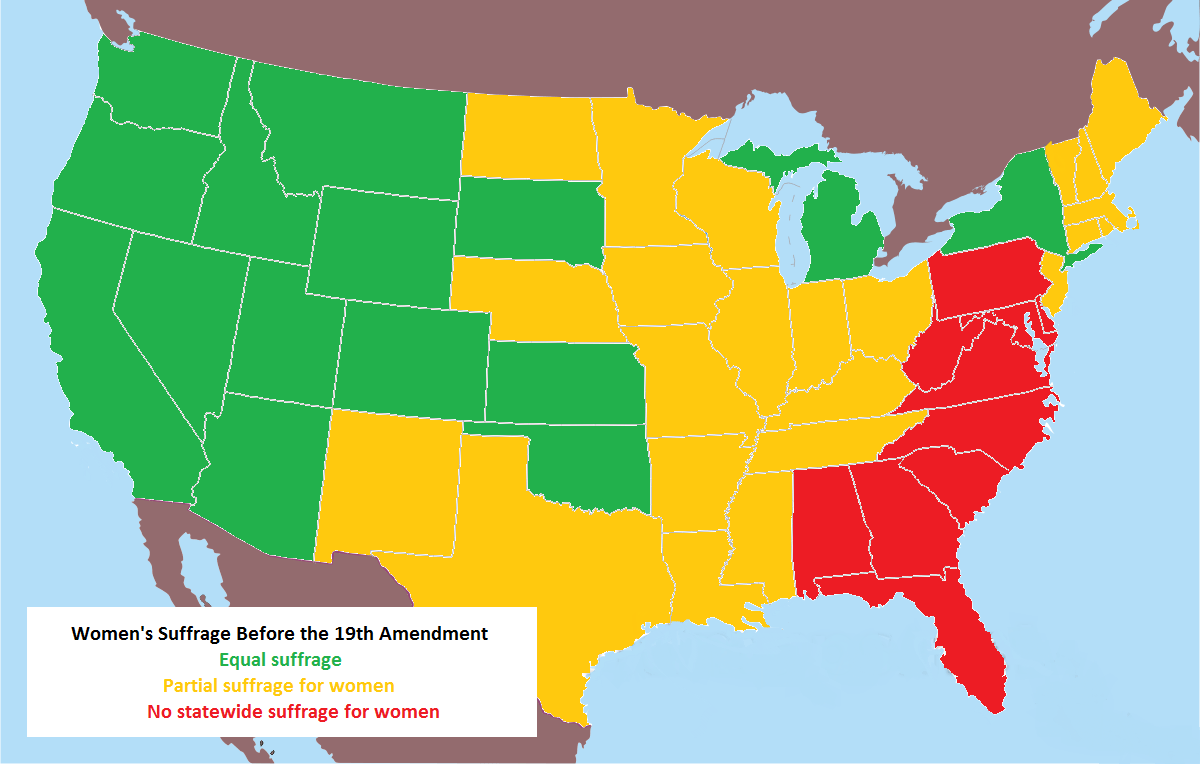
After helping win the fight for an Illinois constitutional convention, Anna Wilkinson* of Alton shifted her energies toward the campaign for national suffrage by means of an amendment to the United States Constitution. She was joined by Angie Schweppe, previously active in the American Woman's League and president of the Alton Woman's Council.
The efforts of women like Wilkinson and Schweppe and countless others paid off. Congress passed the Nineteenth Amendment on June 4, 1919. But there was no rest for the suffragists: now they had to convince at least 36 states to ratify it. Illinois was the very first state to do so (however, due to a "typo" it didn't count; by the time it was corrected six other states had already stepped up).** With ratification by Tennessee on August 18, 1920, the amendment became part of the Constitution. Women had full and equal suffrage at last.
"Be attentive every sister! Hear ye not the ringing note
Loudly pealing forth to womankind that Justice needs her vote;
The Nation's starry emblem o'er no right denied shall float,
And calls us to the fray.
(Chorus)
Hear the call for Woman's freedom!
Help the world through Woman's freedom!
Strike the hour of Woman's freedom!
Her right shall win the day.
Would they lull us with the legend of the ivy and the oak?
'Tis the ivy 'round the home we love whose spirit we invoke.
In its name we'll cast, forever off repression's galling yoke
And end its blighting sway.
(Chorus)
Let us grasp the ballot firmly, and its gift to all demand;
It will be a flaming sword of might, upheld in woman's hand.
And its stroke shall win for righteousness o'er all our hallowed land;
Then use it all who may."
—Song composed by Philip Tindall (Angie Schweppe's nephew) and sung at a meeting of the Alton Woman's Council in March 1919. Source: Alton Evening Telegraph, March 15, 1919.
*For more about Anna Wilkinson, see exhibit pages An Illinois Constitutional Convention and Postscripts.
**Illinois really wanted to be the first to ratify. House Joint Resolution 29 passed unanimously in the Senate and with three opposing House votes on June 10, 1919. But the phrase "all events and purposes" in the Resolution was supposed to read "all intents and purposes." Once the error was found, the vote was retaken on a corrected version (House Joint Resolution 31). By that time—June 17, 1919—Illinois had missed the chance to go down in history as the first to endorse the Nineteenth Amendment.
Postscripts
The Illinois Equal Suffrage Association became the Illinois League of Women Voters soon after the Nineteenth Amendment became the law of the land. The League of Women Voters of Illinois continues today as a nonpartisan resource for voter education and advocate for issues important to League members.
Anna Wilkinson for Mayor
In February 1929, the Alton Evening Telegraph began to buzz with rumors that former women's suffrage activist Anna Wilkinson* would run for mayor in the upcoming election on April 2. If so, she would be Alton's first woman mayoral candidate. Although persistently urged by her supporters to run, Wilkinson did not declare her candidacy until March 13. In a telephone interview, Wilkinson explained:
"[T]elephone messages of an intimidating character were sent to me. I was told I would be better if I stayed out of the contest as disclosures would be made if I became a candidate which would be embarrassing. Those messages made me certain that I would be a candidate."
—Source: Alton Evening Telegraph, March 14, 1929.
Two more latecomers announced their candidacies (former mayor George T. Davis and incumbent Thomas Butler), joining Wilkinson and attorney William Wilson in the mayoral race.
Challengers Davis, Wilkinson, and Wilson met to discuss their chances against the incumbent, Butler. They decided that two of them should drop out of the race to avoid splitting the anti-Butler vote. However, each candidate wanted to be the one to remain on the ticket. Finally Wilkinson decided to withdraw and let the other two candidates hash it out. Her husband delivered her decision to the office of the city clerk on March 20, just minutes before the 5:00 p.m. deadline.
Despite their professed intentions, both Davis and Wilson remained in the race. Wilkinson didn't endorse either candidate, and Butler won reelection on April 2.
*For more about Anna Wilkinson, see exhibit page An Illinois Constitutional Convention.

Info Links
Events
